
Do you read historical plaques while in Paris? If so, I have a surprise for you at the end of this post. It seems you can’t pass a block without coming across a plaque affixed to a building or a Histoire de Paris marker. These markers are often called Pelles Starck or Starck Oars after their designer, Philippe Starck, or in reference to the motto of Paris as a ship:”Fluctuat nec mergitur” (“batted by the waves, but never capsized”).
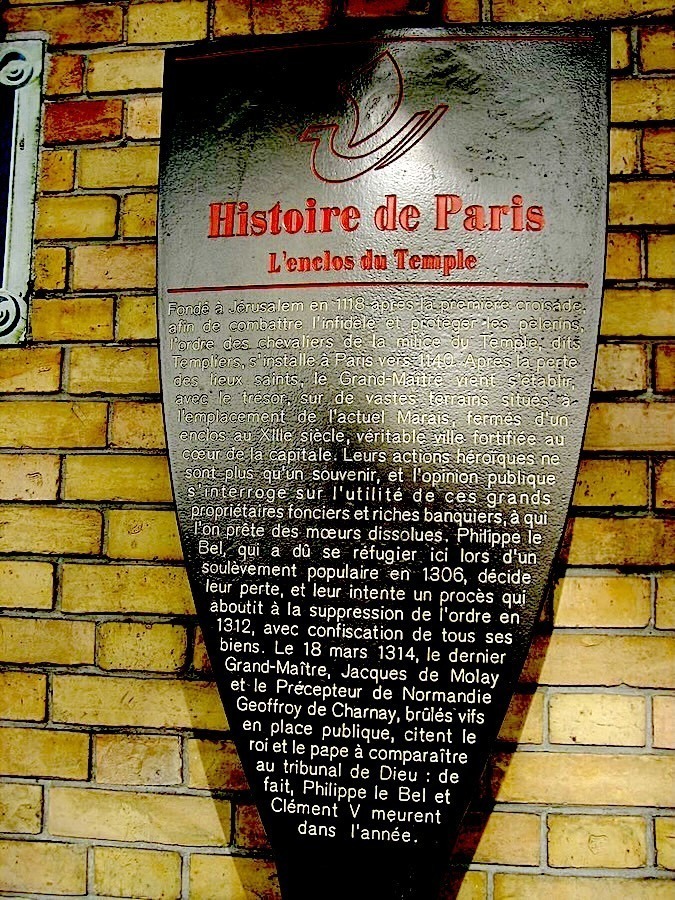
This plaque discusses the site of the Templars stronghold in the Marais.
It annoys traveling companions if I stop to translate a plaque because we would never arrive at our destination; there are simply too many plaques! So instead I’ve taken to photographing them to read later. And now with Google Translate, anyone can enter French text and get an approximation of a translation. Over the years, I’ve built up a large collection of plaque photos, from the huge number honoring the dead of World War II:

to those documenting Jewish deportations:

This plaque honors the Jewsih children deported from the tenth arrondissement of Paris to Nazi concentration camps.
to literary plaques:

The plaques can even be underfoot! Like this one in the 5th arrondissement noting the path of the Bièvre river, at one time very polluted by local tanneries and dyers, and since redirected underground.

I find the plaques very moving and a form of inadvertant time travel. Here I am going about my business, thinking about something I consider important, when I stumble over a reference to something far more important from the past:

This was the former Lévitan department store which was actually a Paris annex of the Drancy concentration camp. Here, hundreds of Jews were forced to sort through furniture and belongings pillaged from other Parisian Jews, constructing a ‘department store’ for Nazis. The sorters were later deported to Auschwitz and Bergen-Belsun.
It forces me to stop and think about all the missing people: those who have died and those who don’t exist because the dead never had a chance to produce offspring. It helps put my trivial concerns in perspective.
Plaques are a great way to learn something new. For instance, I often passed the inelegant cafeteria ‘Flunch’ alongside the unglamourous-but-handy hardware emporium ‘Castorama’ in the 18th:
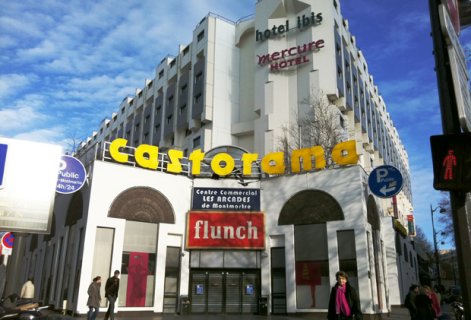 Then I noticed this Starck plaque:
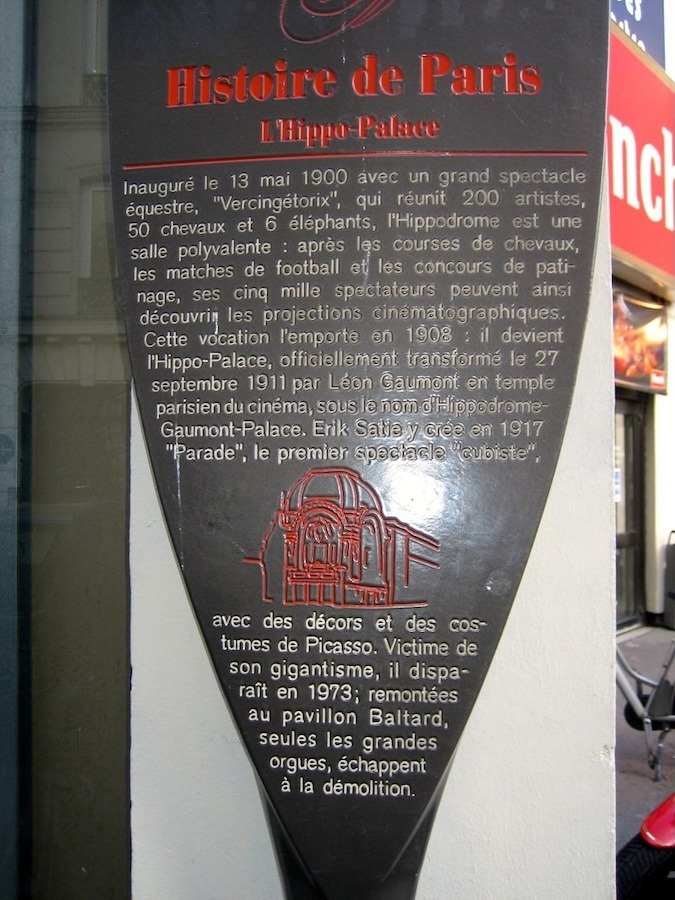
It tells the story of a grand building situated there in 1900 whose opening show featured 200 artists, 50 horses and 6 elephants. it was a multi-purpose venue with horse races, soccer matches, skating competitions and movies.

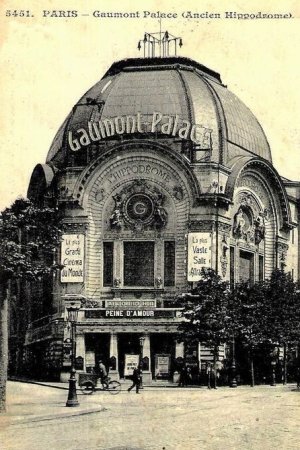
Here it is in 1900. It was converted into a grand ‘temple of the cinema’ in 1911, the largest in the world at that time:
The plaque goes on to say that the famous ballet “Parade” by Erik Satie and Jean Cocteau, with sets and costumes by Picasso and performed by the Ballet Russes, premiered there in 1917. Other sources say it premiered at the Théâtre du Châtelet. Could the plaque be wrong? I don’t care because it turned me on to very interesting history at a seemingly ugly spot and made me look further into the subject.
Apparently other French cities have these as well. Here’s a plaque from Aix-en-Provence:

Now for the surprise: I stumbled across this site with photos of most of the Starck Oars. You can armchair travel across Paris learning history and make notes for places you want to visit.
Enjoy!
Cynthia Tuttelman (aka "Tut") is a writer, family doctor and quilter who lives in Northern California and part-time each year in Paris, France. Follow along and explore the wonders of Paris.