

Wallace Fountains meld so beautifully into their surroundings that you aren’t consciously aware of them. But once they are pointed out, you begin noticing them with delight all over Paris.
Sir Richard Wallace was an Englishman enamored with his adopted city of Paris. He inherited a fortune and decided to utilize it to benefit the city he loved. He founded a hospital and distributed supplies during the Franco-Prussian War. After the war, the city’s water delivery infrastructure was seriously undermined and drinking water became costly and unaffordable to the poor. This inspired Wallace to provide free public drinking water.
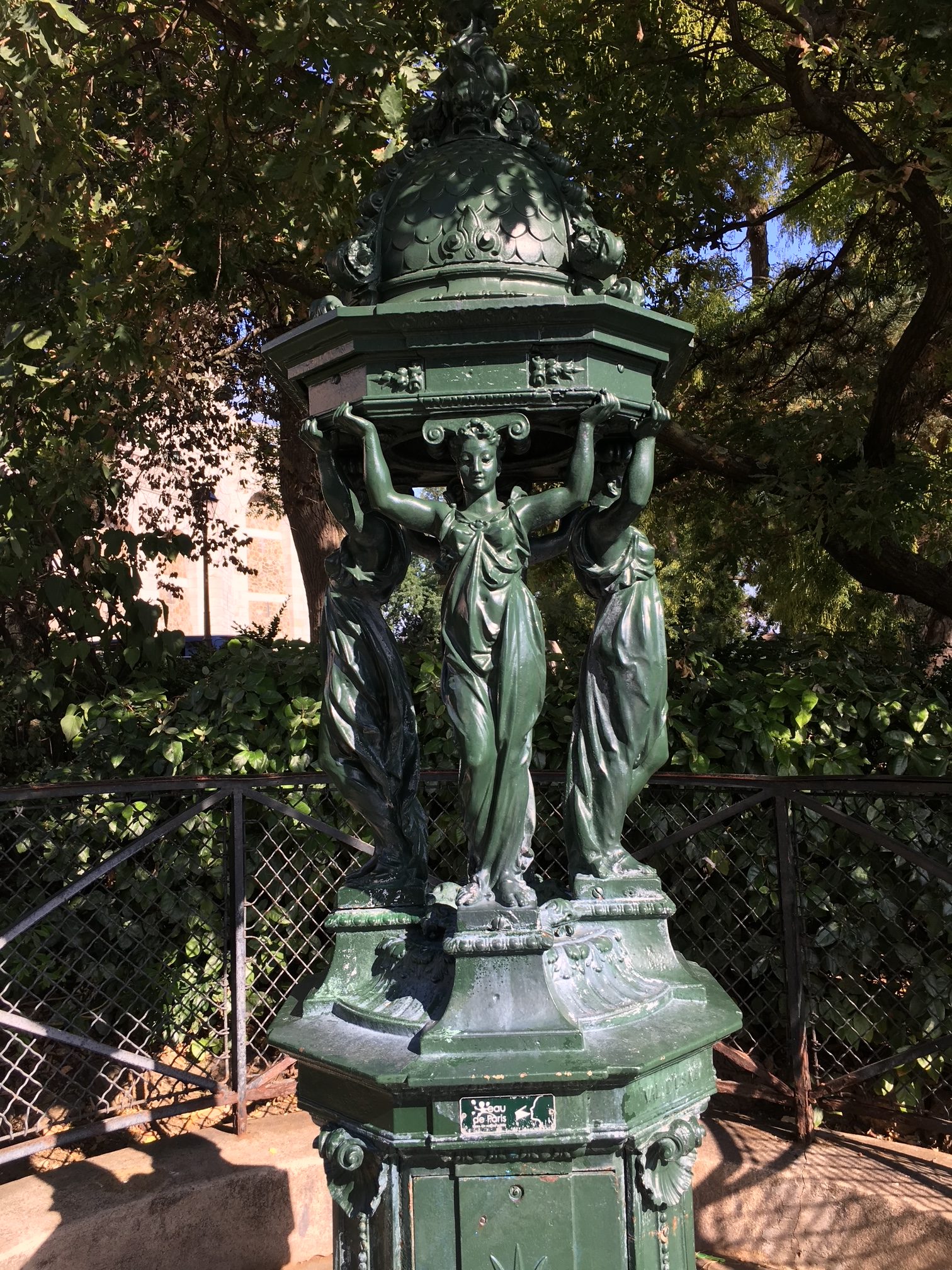
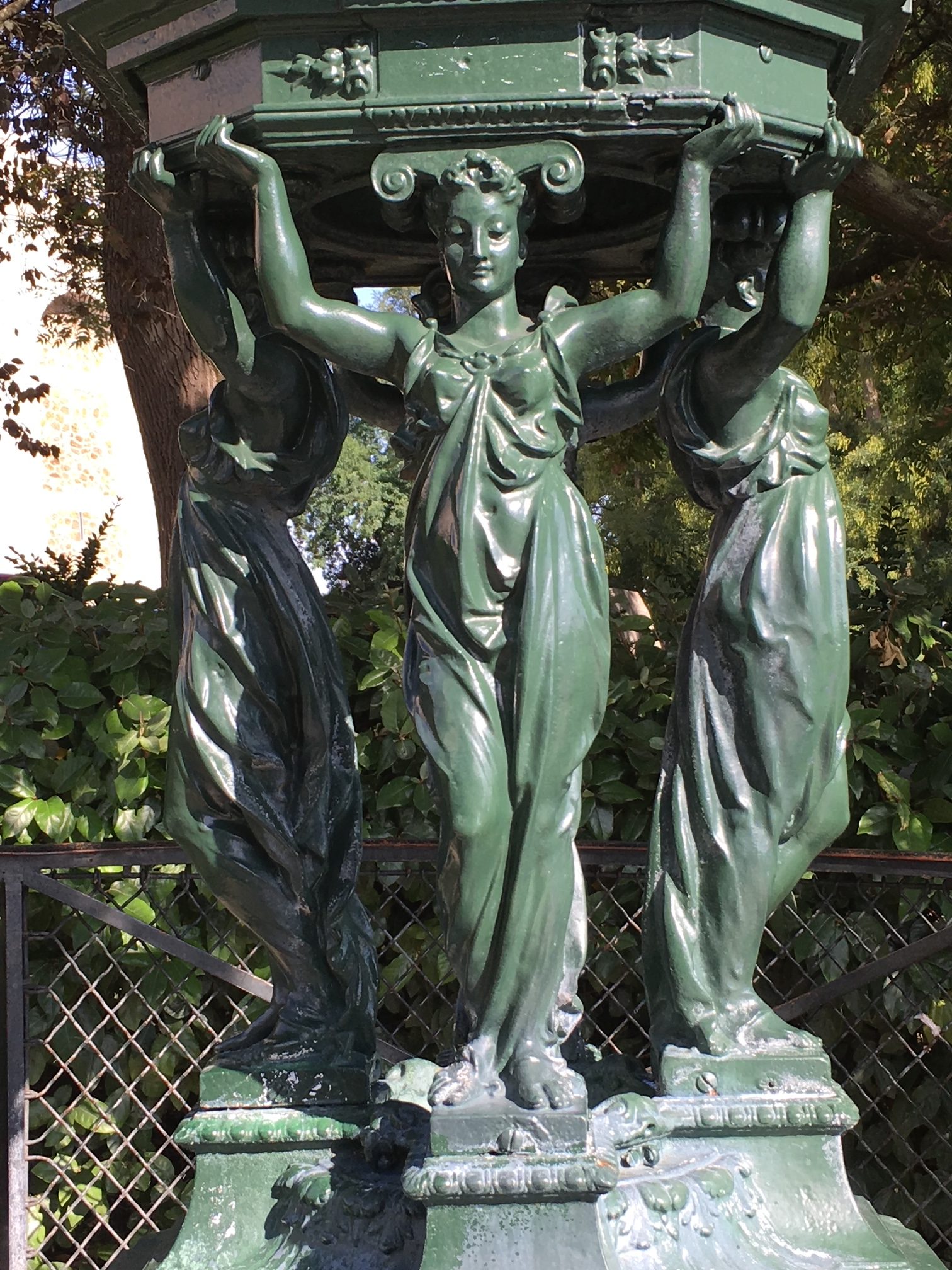
He conceived the fountain’s design of 4 caryatids (representing kindness, simplicity, charity, and sobriety, ) supporting a dolphin-encrusted dome overhead with water trickling down from its center. Originally tin cups were affixed by a chain to permit passers-by the opportunity to easily quench their thirst. He wanted the fountains to be affordable so more could placed around the city and he wanted them to be useful yet beautiful. He intended them to be clearly visible, yet harmonious with their setting. He hired sculptor Charles Auguste Lebourg to execute his conception and the fountains were eventually made of cast iron painted dark green.
The city of Paris chose the locations and the majority are placed in squares. Most are still working but are turned off in the winter so freezing won’t damage the plumbing. They are much loved, but one source states that despite France’s respect for le patrimoine, the 109 Wallace fountains have not been designated as historical monuments. Other cities have embraced the idea and you can find Wallace fountains now in many countries.I carry around a list of Wallace Fountain locations so I can look for them when I visit a different quartier.
Cynthia Tuttelman (aka "Tut") is a writer, family doctor and quilter who lives in Northern California and part-time each year in Paris, France. Follow along and explore the wonders of Paris.